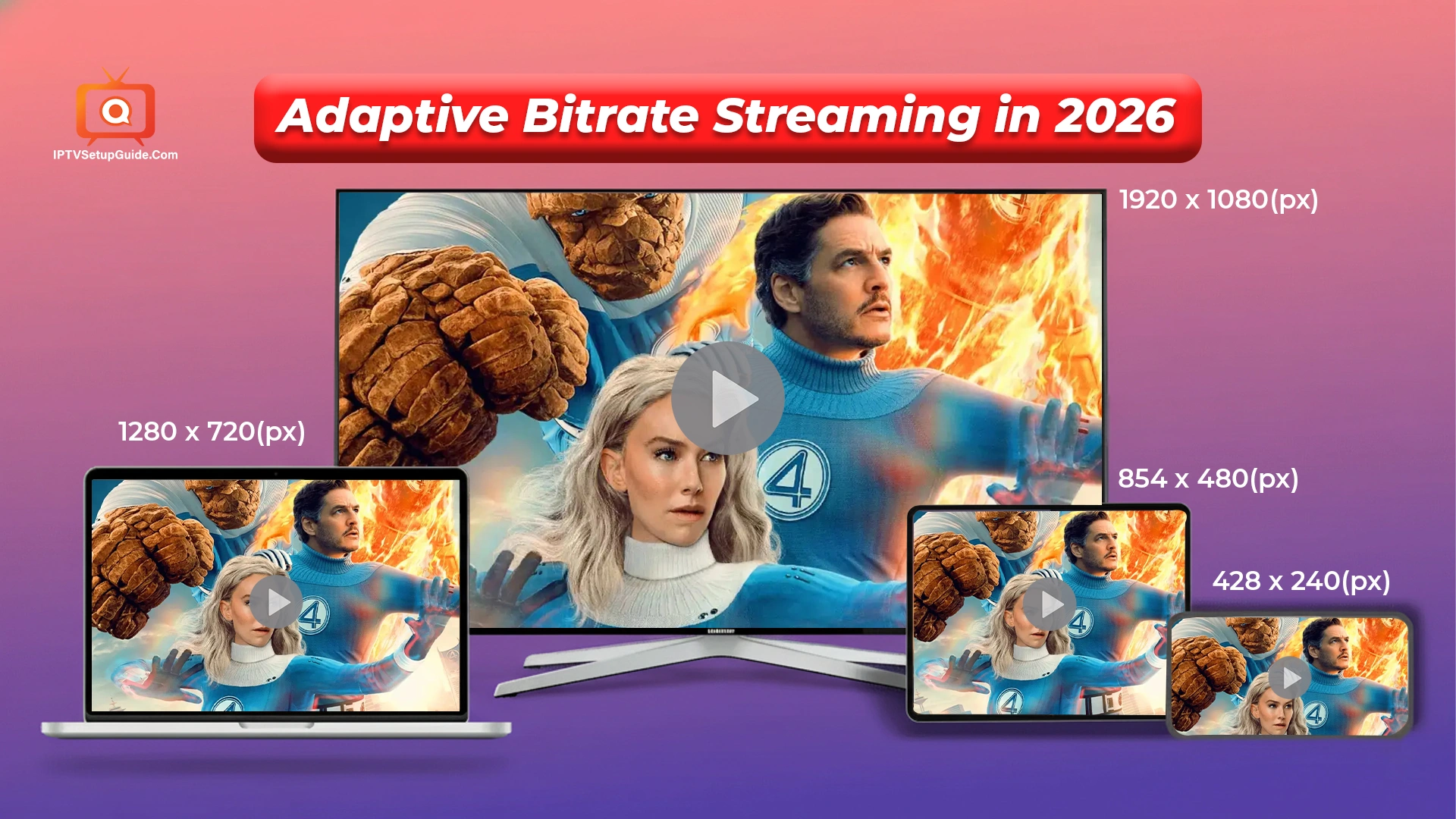
Let’s rewind to 3 or 4 decades ago, when people had to endure extreme difficulties while watching videos due to poor video streaming. Nowadays, things have changed as modern technology is taking over for seamless video streaming – the technology is adaptive bitrate.
Thanks to the vision and hardwork of the developers to make new ways for players and streaming data to connect, there’s no pain of continuous video buffering anymore. The streaming quality has significantly improved, leading to a more sophisticated viewing experience.
Adaptive Bitrate Technology (ABR) helps video streaming data withstand internet fluctuations to keep it smooth, while assisting with bitrate adaptation to mitigate adaptive inconsistency. In this blog, I’ll discuss the adaptive bitrate streaming technology, its work procedures and why it is crucial.
Here we go –
What is Adaptive Bitrate Streaming?
Adaptive Bitrate Streaming (ABS) is a specialized technology that adjusts video quality in real time based on the user’s internet speed and device. It delivers seamless streaming with minimal lag by switching between different bitrates/resolutions. This is how it ensures a smooth and comfortable playback.

Due to its ability to deliver smooth playback in slow/fast internet connections, most OTT (Over-the-Top) platforms and IPTV service providers use this technology to ensure flawless streaming.
How ABR Technology Works?
Here are the 4 easy steps where we’ll see how this Adaptive HTTP Streaming technology works:
- Encoded Different Formats – Firstly, the Dynamic Adaptive Streaming technology receives a video. After checking, this state-of-the-art technology encodes it into multiple versions with different streaming quality levels (480p, 720p) and bitrates (data speeds).
- Fragmenting – Each quality version gets segmented. They convert into short chunks. Conversely, the video player (Tivimate, VLC, KMPlayer, etc.) consistently checks the user’s internet speed and the device’s processing power.
- Dynamic Switching – If the internet bandwidth is high enough, the player requests higher-bitrate chunks, which deliver high-quality video. If the bandwidth is low, the player will request lower-bitrate chunks, resulting in low-quality video streaming.
- HTTP Delivery – The segments are sent to the standard HTTP (Hypertext Transfer Protocol). Thus, they get perfect for a large delivery network like CDN (Content Delivery Network).
Key Advantages of Adaptive Video Streaming Technology
It’s easy to see that poor streaming and video quality can significantly affect users’ streaming experience. This is why Adaptive HTTP Streaming comes into play. Let’s check the 5 best benefits of this highly sophisticated tech –
- Buffer-free Streaming – Since ABR technology can adapt to internet fluctuations and device(s), it can deliver video with minimal buffering.
- Massive Reach – With this tech, streaming reaches across diverse networks, devices, and geographies.
- Seamless Streaming on Smartphones – With ARB technology, it’s possible to enjoy seamless streaming on mobile phones, as there are no more data limitations and a low device processing power mode exists.
- Affordable Path – Dynamic Adaptive Streaming over HTTP (MPEG-DASH) is compatible with most servers and CDNs. Hence, there is no need to set up any specialized servers anymore. It is an economical process while it can still deliver sophisticated streaming.
- Automatic Adjustments – Viewers don’t need to adjust video quality when bandwidth changes manually.
Few Challenges to Face
- Higher Storage Requirements – More and more video files can saturate the CDNs or servers.
- Latency Issues – Some ABS protocols (ex – HLS) might add delays, especially during live streaming or PPV events.
- Bitrate Swinging – The rapid, consistent changes in bitrate can disrupt the streaming experience.
- Creating Algorithms – It’s quite challenging to build a perfect algorithm to maintain that high level of technology, especially for popular PPV events or OTT platforms such as Netflix, Amazon Prime, or HBO Max.
Which Devices and Browsers Use Adaptive Bitrate Technology?
Well, now the question can arise – at which devices and browsers does this technology work? The answer is – it supports most modern and top-notch browsers and devices. Most smartphones, tablets, smart TVs, desktops, laptops, tablets, and streaming media players can seamlessly adjust video quality based on network conditions.
- Mobile devices – iOS and Android devices support ABR through protocols like HLS and MPEG-DASH, either natively or via media players.
- Desktop browsers – Chrome, Edge, Firefox, and Safari support ABR playback using HTML5 video players, with protocol support varying by browser and operating system.
- Smart TVs and streaming devices – Platforms such as Apple TV, Android TV, Roku, Fire TV, and major smart TV operating systems natively support ABR for OTT streaming.
- Gaming consoles – Modern consoles like PlayStation and Xbox support ABR-based streaming apps.
In direct, ABR support depends less on the device itself and more on the protocol and player used. HLS offers the broadest native compatibility, while MPEG-DASH is widely supported through cross-platform players.
Frequently Asked Questions on the Adaptive Bitrate Streaming Technology
Do Netflix and Amazon Prime use adaptive bitrate?
Yes. Both Netflix and Amazon Prime Video use adaptive bitrate (ABR) streaming to adjust video quality in real time based on your internet speed. This helps reduce buffering and keep playback smooth. Netflix commonly uses MPEG-DASH, while Amazon Prime Video mainly uses HLS, but both follow the same ABR principles.
Who created adaptive bitrate technology?
Move Networks created it. Later, big fish like Apple, Adobe, Octashape, etc., also invested their money to acquire this tech.
Which bitrate mode is the best?
The best bitrate mode depends on your goal—quality, stability, or efficiency. The three most popular ones are – CBR, VBR, and CRF, each tailored for different timings.
Is adaptive bitrate good?
Yes. Adaptive bitrate streaming enhances video playback by automatically adjusting quality to match internet speed, reducing buffering and ensuring a smoother viewing experience across devices.
Is adaptive high bitrate better than high quality?
Yes. Adaptive high bitrate delivers the best possible quality for your connection in real time, while fixed high quality can cause buffering if your internet speed drops.
Does YouTube use adaptive bitrate streaming?
Yes. Each YouTube video uses this technology to adapt to different internet speeds and the user’s device power.
Is 8000 bitrate too high for streaming?
It depends. An 8000 kbps bitrate can be fine for 1080p or 4K streaming if you have a fast, stable internet connection. On slower or unstable networks, it may cause buffering.