
Thinking about becoming an IPTV reseller? Search for “IPTV reseller panel” and you’ll find hundreds of panels selling cheap credits for thousands of channels. The problem is that most of them don’t hold the rights to those channels, and resellers are now being sued and warned directly. This guide explains how IPTV resellers work, how to tell a legal IPTV reseller program from an illegal panel, and the best legal ways to resell or wholesale TV in 2026, from white-label IPTV platforms to authorized dealer and affiliate programs.
Key takeaways (TL;DR)
- An IPTV reseller buys access in bulk (often as “credits” on a panel) and sells subscriptions under its own name.
- Reselling is only legal when the content is licensed. Reselling an unlicensed service is copyright infringement: one US reseller was ordered to pay more than $30 million in 2024.
- Legal routes include content cooperatives such as NCTC, white-label platforms such as MwareTV, hardware partners such as Infomir, and authorized retail or affiliate programs for providers like DIRECTV.
- A legal IPTV business needs content licenses, which is why it costs far more to start than a credit panel.
How Do IPTV Resellers Work?
IPTV (Internet Protocol Television) delivers TV channels over the internet. If you’re new to it, start with our guide to what IPTV is and how it works. An IPTV reseller sits between a TV service and the viewer. The usual model looks like this:
- The provider runs the servers, streams and apps.
- The reseller buys access in bulk, often as credits on a reseller panel, where one credit equals one month of service for one customer.
- The customer pays the reseller, usually at a markup, and gets a login, M3U link, or app.
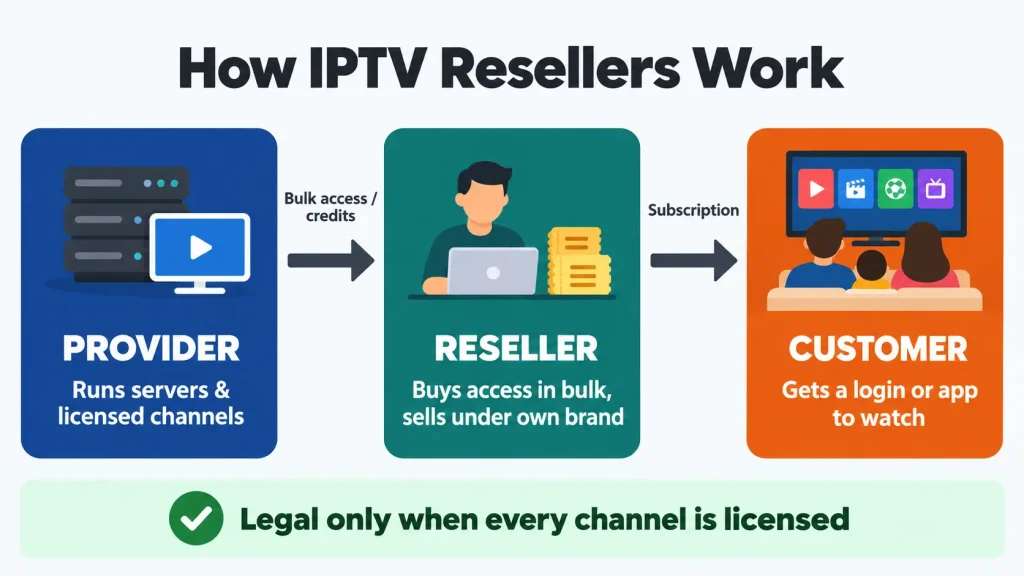
The technology is the same whether the service is legal or not. What makes an IPTV reseller program legal is whether every channel in the package has been licensed from its rights holder, and whether the reseller is authorized to sell it.
Legal vs Illegal IPTV Reseller Panels
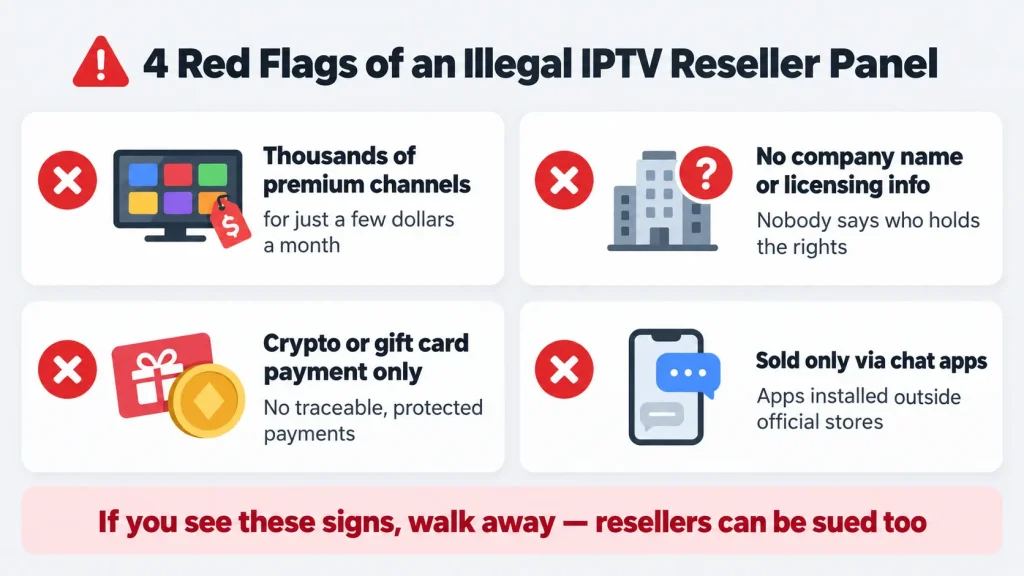
Most IPTV reseller panels you’ll find on Reddit, Telegram, or YouTube sell credits for “full” packages of premium sport, films, and pay-TV channels at prices no licensed service could match. Those packages are almost always unlicensed. Watch for these red flags:
- Thousands of channels, including premium sport and pay-TV, for a few dollars a month per customer.
- No company name, address or licensing information, and no answer when you ask who holds the rights.
- Payment only by crypto, gift cards or transfers to individuals.
- Instructions to sell through WhatsApp or Telegram and avoid official app stores.
Rights holders now go after resellers, not just the services behind them:
- USA: in April 2024, a federal judge ordered a Texas reseller of the defunct Beast TV service to pay more than $30 million for at least 12,000 subscriptions, after a lawsuit by DISH Network, TROYPOINT reported.
- Ireland: in July 2026, anti-piracy group FACT and Sky sent cease-and-desist notices to 10 suspected illegal IPTV resellers across Ireland, warning of civil action or referral to the Gardaí, according to Advanced Television. FACT’s investigation manager said illegal streaming “depends on a chain of people who promote, sell and provide access to unauthorized content.”
For the full picture by country, read is IPTV legal? (This is general information, not legal advice.)
Best Legal IPTV Reseller Programs 2026
These programs let you resell, wholesale or build a TV business legally. None of them hands you a ready-made bundle of pirated channels. Instead, they give you licensed content, a platform, hardware or an authorized sales channel.
1. NCTC: best for wholesale licensed content
The National Content & Technology Cooperative (NCTC) negotiates programming deals for independent US operators. It has more than 700 independent communications and technology service provider members, and master licensing agreements covering more than 200 networks.
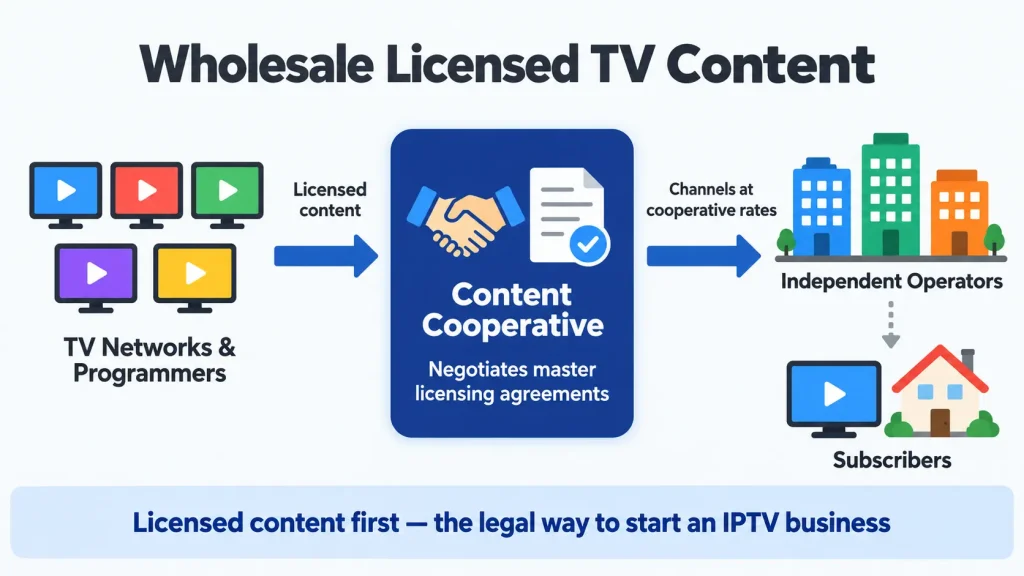
- What it offers: master content agreements, consolidated billing for content fees, marketing support from programmers, forecasting tools and account managers.
- Best for: independent broadband, cable and fiber operators that want to launch a legal TV or IPTV service.
- Pros: access to licensed channels at cooperative rates, which is the hardest part of a legal IPTV business.
- Cons: designed for established operators, not individual resellers, and pricing isn’t public.
2. MwareTV: best white-label IPTV platform
MwareTV provides a ready-built IPTV and OTT platform that you launch under your own brand. Your logo, colors and app name appear across apps, the web portal and invoices, while MwareTV’s middleware, CDN and transcoding stay hidden.
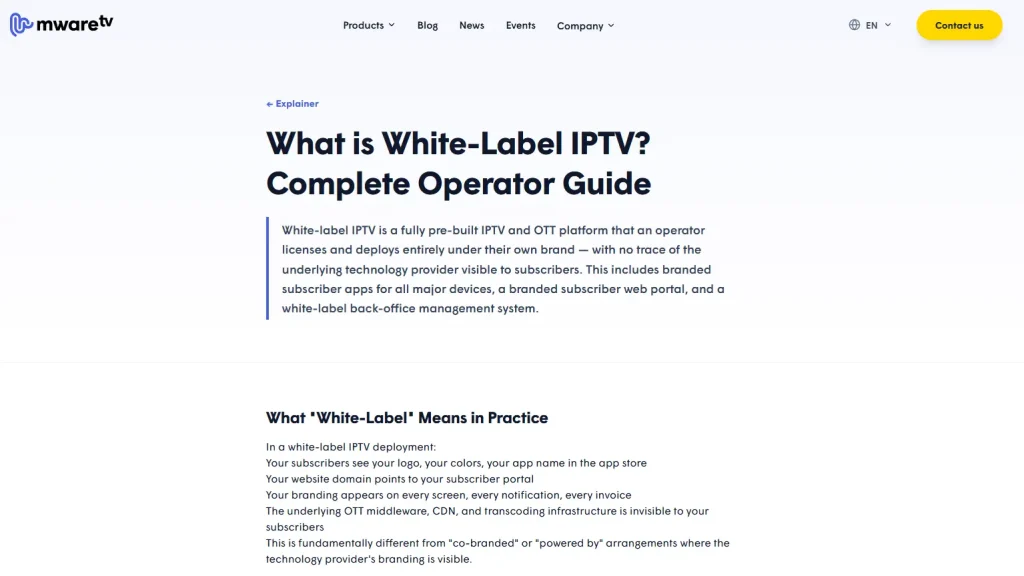
- What it offers: branded apps for 15+ platforms (iOS, Android, Apple TV, Roku, Samsung, LG and Fire TV), a subscriber portal, billing, DRM and a back office that can be white-labelled for your own resellers.
- Best for: wholesale operators reselling to regional ISPs, media groups and telcos.
- Pros: launch in about 6–8 weeks, according to MwareTV, and you set your own prices.
- Cons: you must license your own content. MwareTV states that “Operators must obtain content rights from respective content owners.” Pricing isn’t published.
3. Infomir: best for IPTV hardware and middleware partners
Infomir, the maker of MAG set-top boxes, runs partnership programs for distributors, operators and system integrators. It offers the Ministra and Ministra PRO middleware platforms and says it has more than 50 partners.
- What it offers: set-top boxes, middleware and customization options for operators and distributors.
- Best for: ISPs, trading companies and IPTV/OTT operators that need hardware and a management platform.
- Pros: an established hardware brand with its own middleware.
- Cons: hardware and software only, with no content included, and partnership terms aren’t published.
4. AT&T Authorized Retail Program: best for selling licensed TV in the USA
The AT&T Authorized Retail Program lets qualified businesses become authorized retailers of AT&T products, including DIRECTV, AT&T Fiber and AT&T Mobility.
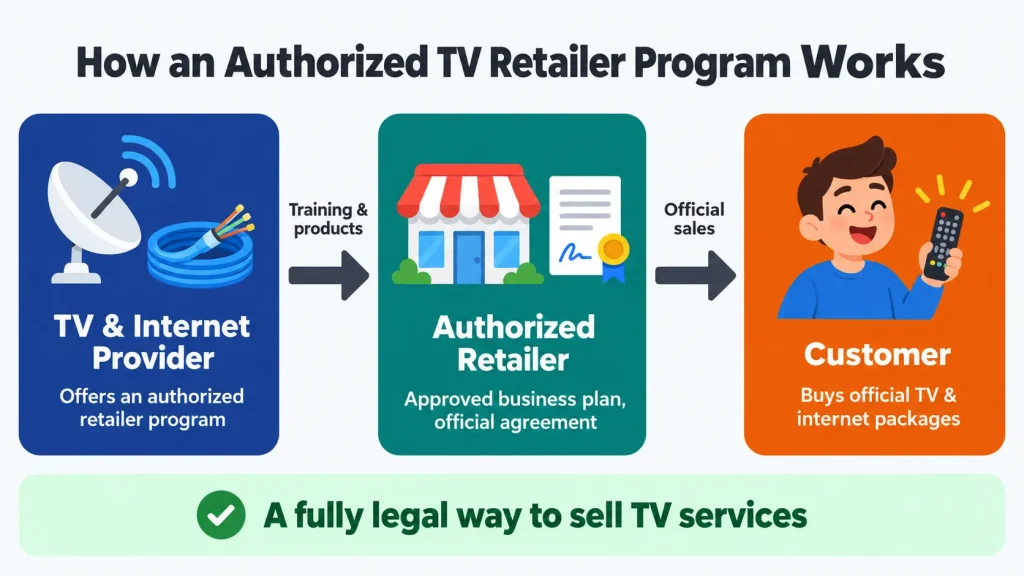
- What it offers: the right to sell licensed TV and internet services under an official agreement.
- Requirements: a business plan and the resources to carry it out. Fees and territories aren’t listed publicly.
- Pros: fully legal, well-known brands that customers trust.
- Cons: you sell the provider’s packages at its prices, not your own channel line-up.
5. DIRECTV affiliate program: best for websites and creators
If you run a website or social channel, an affiliate program is the simplest legal way to earn from TV sales. The DIRECTV and AT&T affiliate program on FlexOffers lists payouts of $38.40–$64.00 per sale, with a 30-day cookie.
- What it offers: commission for referring customers to DIRECTV and AT&T services.
- Pros: no stock, no servers and no licensing risk.
- Cons: payouts depend on the service and the customer’s credit approval, and the listing doesn’t confirm that the program is currently active.
Legal IPTV Wholesale in Canada: The VMedia Example
Canada shows how a smaller company can resell TV and internet legally. VMedia, a Toronto-based provider, pays wholesale rates to Bell, Rogers and TELUS for network access and repackages it as its own service, and it sells TV packages alongside internet. Quebecor acquired VMedia in 2022, according to iPhone in Canada. A cloud-based, white-label IPTV platform reseller in Canada works the same way: it needs both network access and licensed channels from Canadian broadcasters.
IPTV Reseller Programs Compared
| Program | Type | Best for | Content included? | Public pricing? |
|---|---|---|---|---|
| NCTC | Content cooperative | Independent operators | Yes, licensed (200+ networks) | No |
| MwareTV | White-label platform | Telcos and wholesale operators | No, you license it | No |
| Infomir | Hardware and middleware | ISPs and distributors | No | No |
| AT&T Authorized Retail | Authorized retailer | Shops and sales businesses | Yes, DIRECTV packages | No |
| DIRECTV affiliate | Affiliate | Websites and creators | N/A (referrals) | $38.40–$64.00 per sale |
Our verdict: the best IPTV reseller option depends on your scale. Operators should combine NCTC (content) with a platform like MwareTV or Infomir, retail businesses should join an authorized program like AT&T’s, and websites should start with an affiliate program. All five are legal ways to earn from TV, unlike credit panels for unlicensed services.
How to Become an IPTV Reseller Legally
Here’s how to become an IPTV reseller without the legal risk:
- Choose your model: affiliate, authorized retailer, or your own branded service.
- Secure the content rights: sign an agreement with a licensed provider, or license channels directly or through a cooperative.
- Pick your technology: a white-label platform, middleware and, if needed, set-top boxes. Our guide to choosing an IPTV encoder covers the headend side.
- Register your business: sort out company registration, tax, payments and terms of service.
- Market honestly: show your company details and licensing, and sell through official app stores.
For a step-by-step plan, read our guide on how to start an IPTV business.
Frequently Asked Questions About IPTV Resellers
-
Is reselling IPTV illegal?
Reselling IPTV is legal only when the service is licensed and you’re authorized to sell it. Reselling an unlicensed service is copyright infringement: in 2024, a US reseller was ordered to pay more than $30 million to DISH Network. Read IPTV legality explained.
-
Is buying IPTV legal in the USA?
Yes, buying IPTV from licensed services such as YouTube TV, Sling TV, Hulu + Live TV or Philo is legal. Buying from unlicensed sellers isn’t, and those services can disappear overnight. Compare licensed options in our guide to IPTV in the USA.
-
Where can I find IPTV sellers?
Buy from licensed providers directly or from their authorized retailers, such as AT&T’s authorized retail network for DIRECTV. Our list of legal IPTV services covers licensed options by country.
-
Where can I find wholesale IPTV products?
For licensed content, operators can join a cooperative like NCTC or deal directly with broadcasters. For technology, white-label platforms such as MwareTV and hardware makers such as Infomir sell to operators. Be wary of “wholesale credits” with no licensing information.
Final Thoughts: Becoming an IPTV Reseller the Right Way
Becoming an IPTV reseller can be a real business, but only with licensed content. Cheap reseller panels might promise quick profits, yet resellers now face lawsuits, warnings and lost customers when services are shut down. Start with an affiliate or authorized retail program, or build a branded service on a white-label platform with properly licensed channels. To understand the market first, revisit how IPTV works, see the best IPTV service providers, and plan your launch with our IPTV business guide.