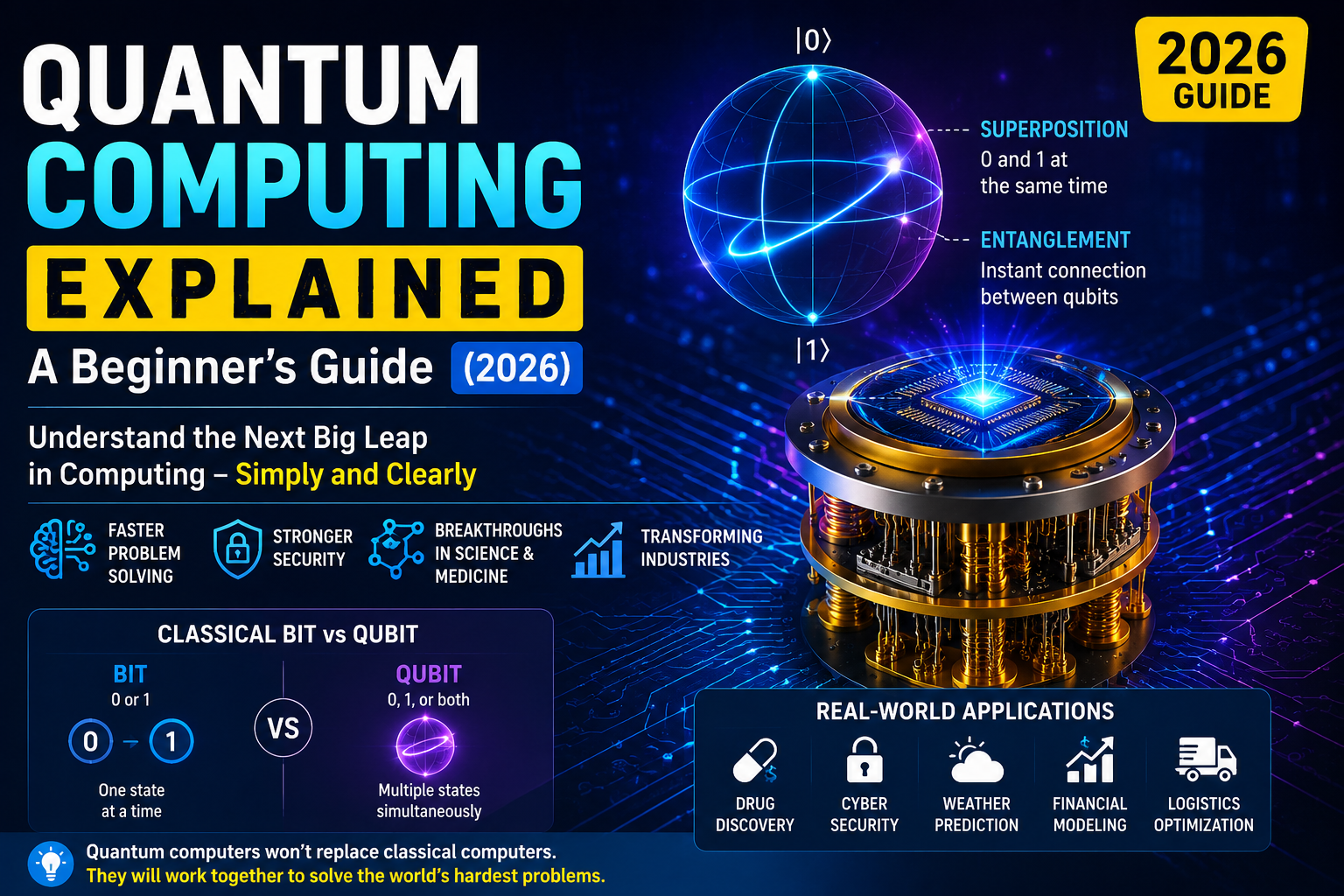
Imagine a computer so powerful that it could solve problems in minutes that would take today’s fastest supercomputers thousands of years. That is not science fiction anymore. It is the reality researchers are chasing through quantum computing.
From breaking complex encryption to accelerating drug discovery and climate modeling, quantum computers are reshaping the future of technology.
Major companies like IBM, Google Quantum AI, and Microsoft Quantum are investing billions into the field. According to industry estimates, the global quantum computing market could exceed $90 billion by 2035.
By the end, you’ll understand quantum computing better than 99% of the people who casually drop the phrase in conversation. Let’s go.
What is Quantum Computing?
Quantum computing is an advanced form of computing that uses the principles of quantum mechanics to process information.
Unlike traditional computers that use binary bits represented as either 0 or 1, quantum computers use qubits, which can exist in multiple states simultaneously.
This allows quantum systems to process enormous amounts of information far more efficiently for certain complex problems.
In simple terms:
Classical computers think step by step. Quantum computers explore many possibilities at the same time.
That capability could revolutionize fields such as:
- Artificial intelligence
- Cryptography
- Drug discovery
- Financial modeling
- Weather prediction
- Logistics optimization
How is it Different from Classical Computing
Classical computers, the kind you’re reading this on, store information in bits. A bit is a tiny switch that holds either a 0 or a 1.
Quantum computers use qubits (short for quantum bits). A qubit can hold 0, 1, or a mixture of both at the same time. This is the source of all the magic, and also why the field feels strange at first.
Here is a quick side-by-side:
| Feature | Classical Computer | Quantum Computer |
| Basic unit | Bit (0 or 1) | Qubit (0, 1, or both) |
| Processing style | Sequential | Massively parallel for certain problems |
| Operating temperature | Room temperature | Near absolute zero (-273°C) |
| Error rate | Practically zero | High requires error correction |
Best at | Everyday tasks | Simulation, optimization, and certain math |
| Replaces the other? | No | No |
| Current users | Everyone | Researchers, labs, early enterprise |
The headline takeaway: Classical and quantum computers are not competitors. They are tools for different jobs, and in most real deployments, they work side by side.
A classical computer prepares the data, a quantum computer crunches the hardest math, then a classical computer handles the output.
The Three Ideas that Make Quantum Computing Work
To understand quantum computing, you need three concepts. Once you get these, the rest of the field makes sense.
Superposition
Imagine a spinning coin. While it spins in the air, it is neither heads nor tails, in some sense it is both. Only when you grab it does it settle into one outcome.
A qubit works the same way. While it computes, it can hold many possible answers at once. The moment you measure it, it picks one.
This is why quantum computers are so powerful for certain problems. With 3 classical bits, you can represent one of 8 numbers. With 3 qubits in superposition, you can represent all 8 at the same time.
With 50 qubits, you can hold more than a quadrillion states simultaneously. The math compounds quickly.
Entanglement
Take two qubits and link them together so that they share a single quantum state. Whatever happens to one instantly affects the other, even if you separate them by the length of a football field, a planet, or a galaxy.
Einstein called this “spooky action at a distance” because it seemed impossible. It is real and it has been confirmed by experiments hundreds of times. Entanglement is what allows qubits to coordinate during a calculation in ways classical bits never could.
Interference
Quantum systems behave like waves. Two waves meeting can either reinforce each other or cancel out. A clever quantum algorithm uses interference to amplify the right answer and cancel out the wrong ones, so when you finally measure, the correct result is the most likely outcome.
Superposition gives quantum computers their reach. Entanglement gives them their coordination. Interference is what allows them to produce a useful answer in the end.
How a Quantum Computer Actually Works (Step-by-Step Guide)
A real quantum computation, even on the most advanced hardware in 2026, follows the same five steps:
- Initialize the qubits. Every qubit is reset to a known starting state, typically 0.
- Apply quantum gates. Gates are operations that manipulate qubits, similar to how AND, OR, and NOT gates work in classical computers, but with quantum effects layered on top.
- Build a quantum circuit. A sequence of quantum gates designed to solve a specific problem becomes a quantum circuit. A quantum algorithm is the recipe behind that circuit.
- Measure the qubits. The qubits collapse from superposition into definite 0s and 1s. This is the output.
- Repeat thousands of times. Quantum measurements are probabilistic, so you run the circuit many times and look at the distribution of results.
The hardware doing all this is exotic. Most quantum computers operate at temperatures colder than deep space, around 15 millikelvin, to keep the qubits stable.
Vibrations, heat, and electromagnetic noise can disrupt the system, a problem called decoherence, which is currently the single biggest obstacle to scaling these machines up.
Where Quantum Computing Stands in 2026
This is the part most beginner guides skip. Quantum computing in 2026 is not science fiction, but it is not your iPhone either. The current era is called NISQ, short for Noisy Intermediate-Scale Quantum.
Three milestones from the last 18 months matter:
- Google Willow (December 2024). A 105-qubit chip that demonstrated the first sub-threshold quantum error correction, meaning errors can, in principle, be reduced faster than they accumulate. This is the result that made the broader physics community sit up.
- IBM’s quantum advantage target. IBM has publicly committed to demonstrating the first practical quantum advantage by the end of 2026. It means a quantum computer solving a useful real-world problem better than any known classical method.
- Microsoft’s topological qubits. Microsoft unveiled progress on topological qubits in 2025, an exotic and harder-to-build qubit design that may be much more stable than today’s superconducting alternatives.
So the situation: quantum computers exist, they are useful for research, and they are beginning to whisper their first hints of commercial value. The bigger transformations are still ahead.
Real-World Applications of Quantum Computing
Where will quantum computing actually matter? A few specific areas, each backed by serious investment in 2026.
Drug discovery and molecular simulation. Drug molecules are quantum systems by nature, so simulating them on a classical computer is brutally inefficient. Quantum computers should eventually simulate them directly. Pharma giants such as Merck, Roche, and Boehringer Ingelheim already have quantum partnerships.
Materials science. Designing new battery chemistries, superconductors, and catalysts at the atomic level. Quantum simulation could shrink decade-long materials research into months.
Optimization problems. Routing fleets of delivery trucks, balancing financial portfolios, scheduling airline crews. Any problem with a vast number of possible combinations is a candidate for quantum acceleration.
Cryptography (both ways). Quantum computers will eventually break much of the encryption currently securing the internet. They will also enable new forms of quantum-secure communication.
Artificial intelligence and machine learning. Quantum machine learning is an active research area, with potential speedups for certain training and pattern-recognition tasks.
Finance. Risk modeling, derivatives pricing, fraud detection. JPMorgan, Goldman Sachs, and HSBC all run quantum research programs.
These applications are not all here today, but the foundations are being laid right now, and the first practical wins are expected in 2026 and 2027.
The Post-Quantum Cryptography Problem (Why This Matters Now)
This is the quantum story almost no beginner guide explains, and it is the one most likely to affect you in the next 5 years.
Most of today’s internet security relies on mathematical problems that classical computers cannot solve in a reasonable time. Cracking the encryption on your banking app, for example, would take the world’s fastest classical supercomputer longer than the age of the universe.
A sufficiently large quantum computer, running an algorithm called Shor’s algorithm, could solve those same problems in hours.
The quantum computer big enough to do this does not exist yet. But adversaries already harvest encrypted data today, expecting to decrypt it later when the hardware catches up.
This is called the “harvest now, decrypt later” threat, and it is why governments and major companies are scrambling to migrate to post-quantum cryptography, new encryption methods designed to resist quantum attacks.
The US National Institute of Standards and Technology (NIST) finalized its first post-quantum cryptographic standards in 2024. Migration is underway across banking, defense, and tech infrastructure right now. If you work in IT or security, this is not a future problem. It is a 2026 problem.
Who’s Leading the Quantum Race
The quantum computing industry in 2026 is concentrated around a handful of major players, each pursuing a slightly different technical approach.
| Company | Approach | Status in 2026 |
| IBM | Superconducting qubits | Largest public roadmap, targeting quantum advantage by the end of 2026 |
| Superconducting qubits | Willow chip, leader in error correction research | |
| Microsoft | Topological qubits | Exotic but potentially more stable, early-stage |
| IonQ | Trapped ions | Higher qubit fidelity, smaller systems |
| Rigetti | Superconducting qubits | Mid-size player, public on NASDAQ |
| PsiQuantum | Photonic qubits | $1.3B+ in funding, planning 2026 IPO |
| Quantinuum | Trapped ions | Honeywell + Cambridge Quantum merger |
| D-Wave | Quantum annealing | Different paradigm, focused on optimization |
No single approach has won. Superconducting qubits (Google, IBM) lead in qubit count. Trapped ions (IonQ, Quantinuum) lead in stability. Photonics (PsiQuantum) leads in long-term scalability potential. The next 5 years will tell us which approach reaches fault tolerance first.
Challenges Still Facing Quantum Computers
Quantum computing is hard, and being honest about why is part of understanding the field.
- Decoherence. Qubits lose their quantum state when disturbed by heat, vibration, or stray electromagnetic noise. Keeping them stable long enough to compute is brutal engineering.
- Error correction. Today’s quantum computers make far more errors than classical ones. Building a “fault-tolerant” quantum computer requires using many physical qubits to represent a single reliable “logical qubit.” Estimates suggest a million-plus physical qubits may be needed for full fault tolerance. We have about 1,000 today.
- Scaling hardware. Adding more qubits without losing fidelity is an enormous physics and engineering problem.
- Workforce shortage. There are not enough quantum engineers, algorithm developers, or error-correction specialists. Universities are scrambling to expand programs.
- Cost. A single state-of-the-art quantum computer costs tens of millions of dollars and requires specialized facilities.
Each of these is being worked on right now, with serious money and serious talent behind them.
The Honest Timeline: When will Quantum Computers Actually Change Your Life
A realistic read on where this is heading:
- 2026 to 2027: First practical quantum advantage on narrow, useful problems. Mostly relevant to researchers, pharma, finance, and materials science.
- Late 2020s: Early fault-tolerant prototypes. Specialized commercial deployments expand.
- 2030s: Commercial fault-tolerant quantum computers begin solving problems with measurable real-world impact in drug discovery, materials, and optimization.
- 2040s: Broad industrial transformation. Quantum computing is becoming part of the standard scientific and industrial workflow, much like GPUs are today.
This is not a deferral. It is what the physics, engineering, and investment data actually point to. The trajectory has compressed dramatically in the last two years, and it could compress further.
But anyone telling you quantum computers will be cracking your passwords or curing cancer by next Tuesday is selling you something.
How to Start Learning Quantum Computing
If this has sparked your curiosity, here is the most effective path in 2026:
- For absolute beginners: Read Quantum Computing for Everyone by Chris Bernhardt. Requires no math, builds genuine intuition.
- For Python programmers: IBM’s free Qiskit framework, paired with their online textbook, lets you run real quantum circuits on actual IBM quantum hardware in the cloud.
- For visual learners: Google’s Quantum AI YouTube channel and 3Blue1Brown’s quantum series.
- For careers: Quantum algorithm development, quantum hardware engineering, and post-quantum cryptography are three of the fastest-growing specialty paths in tech.
You do not need a physics PhD to be useful in quantum computing. You need curiosity, patience, and willingness to be wrong about your intuitions for a while.
Final Thoughts: The Future of Quantum Computing
The next decade could determine whether quantum computing becomes as transformative as the internet itself.
Researchers are already pushing toward:
- Logical qubits
- Quantum error correction
- Fault-tolerant systems
- Large-scale processors
- Quantum internet infrastructure
Companies and governments worldwide are investing billions because the potential rewards are enormous.
Still, experts caution that fully mature quantum computing remains years away.
What is certain, however, is this:
Quantum computing is no longer a theoretical science. It is becoming a real technological frontier.
FAQs on Beginner’s Guide to Quantum Computing
What is quantum computing in simple terms?
Quantum computing is a new type of computing that uses qubits and quantum mechanics to solve complex problems faster than classical computers.
What is a qubit?
A qubit is the quantum version of a classical computer bit. Unlike regular bits, qubits can exist in multiple states simultaneously.
How does quantum computing work?
Quantum computers use superposition, entanglement, and quantum algorithms to process information differently from traditional computers.
Why is quantum computing important?
Quantum computing could revolutionize medicine, cybersecurity, AI, logistics, and scientific research by solving extremely complex calculations faster.
Can quantum computers break encryption?
Potentially yes. Quantum algorithms like Shor’s Algorithm could eventually break some traditional encryption systems.
Will quantum computers replace normal computers?
No. Quantum systems are designed for specialized calculations, while classical computers remain better suited for everyday tasks.
What are the biggest challenges in quantum computing?
The main challenges include quantum decoherence, error correction, qubit stability, and scalability.
Can beginners learn quantum computing?
Yes. Many free platforms, courses, and cloud quantum simulators now make quantum computing accessible to beginners.
Is quantum computing available today?
Yes, but mostly for research and experimentation. Large-scale commercial quantum computing is still developing.