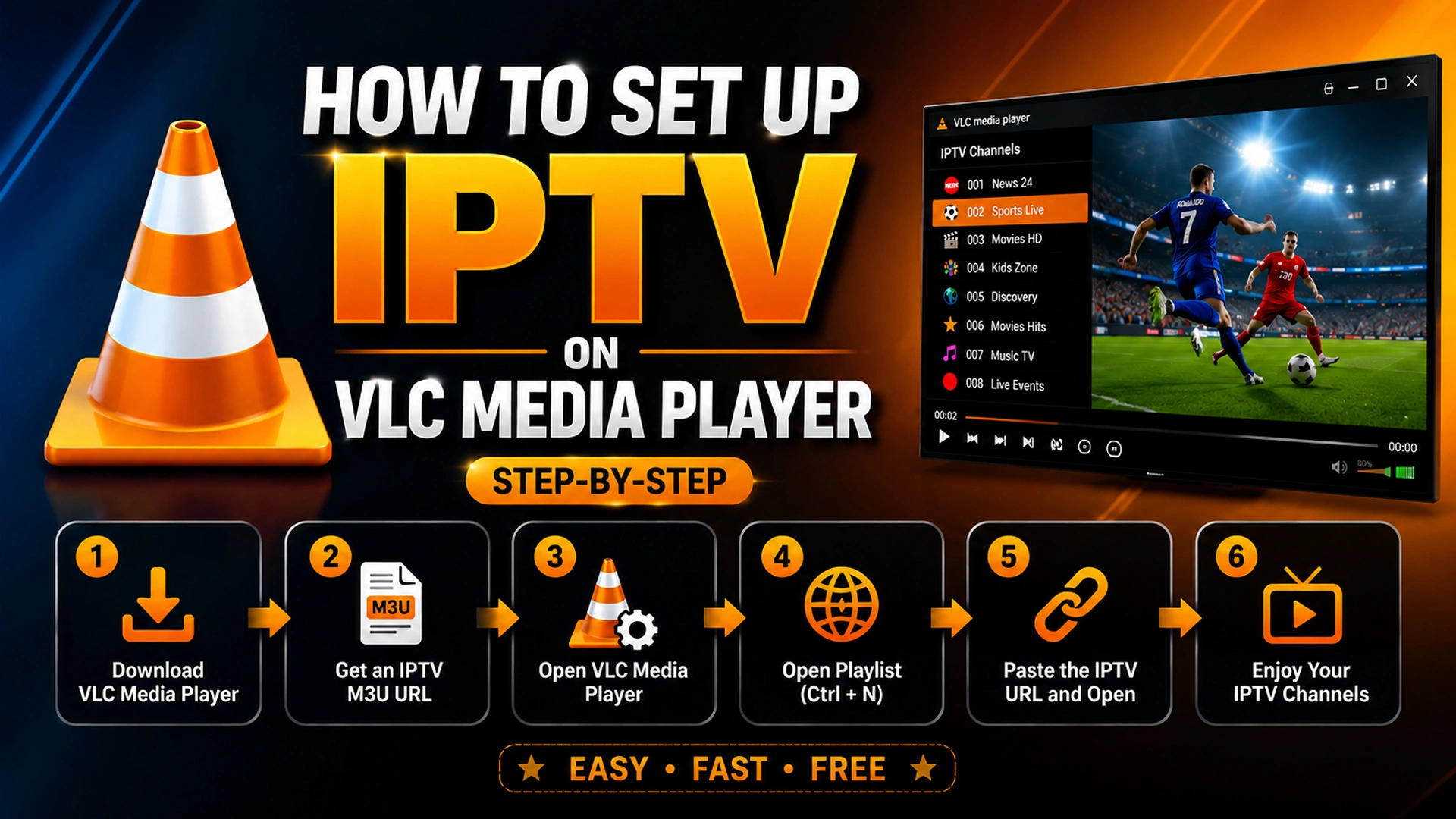
VLC is one of the most popular media players and is widely used by millions of entertainment enthusiasts. It’s also popular with IPTV users. But most people have little idea of how to get the best out of it.
Most IPTV users install dedicated IPTV apps without realizing that VLC Media Player can stream M3U playlists, live TV channels, movies, and network streams completely free.
VLC Media Player is one of the world’s most trusted open-source media players, known for its lightweight performance, broad codec support, and compatibility with Windows, macOS, Linux, Android, and iPhone.
According to VideoLAN, VLC has surpassed 6 billion downloads worldwide, making it one of the most widely used media players available.
Whether you want to stream IPTV using an M3U playlist or test your provider’s network stream, VLC offers a simple and reliable solution without requiring a dedicated IPTV app or user account.
In this guide, you’ll learn how to set up IPTV on VLC Media Player, add M3U playlists, optimize playback, fix buffering issues, explore VLC’s best features, and choose the right settings for smooth IPTV streaming across all major devices.
Here we go!
| Disclaimer: IPTVRepair does not provide or host IPTV services, playlists, or streaming content. VLC Media Player is a legal media player, and this guide is for educational purposes only. Always use a valid IPTV subscription and stream content in accordance with your local laws and your provider’s terms of service. |
IPTV on VLC Media Player
IPTV on VLC lets you stream live TV channels using an M3U playlist or network stream URL. VLC Media Player is a free, open-source media player that supports IPTV playback on Windows, macOS, Linux, Android, and iOS without requiring a dedicated IPTV app.
VLC Media Player supports IPTV through M3U and M3U8 playlists. Simply open Media → Open Network Stream, paste your playlist URL, and click Play. VLC works on Windows, macOS, Linux, Android, and iPhone without requiring a dedicated IPTV application.
For IPTV streaming, VLC matters because it supports the exact stream types that IPTV providers deliver:
- M3U and M3U8 playlists (the universal format for IPTV channel lists)
- HLS (HTTP Live Streaming) – the protocol behind most modern live streams
- RTSP, UDP, RTP, and MMS – legacy and specialty streaming protocols
- MPEG-TS (Transport Stream) – the container used for broadcast-grade video
Why Choose VLC for IPTV?
VLC Media Player is a free, open-source media player that supports IPTV via M3U playlists and network streams. Although dedicated IPTV apps offer more advanced features, VLC remains a lightweight, reliable, and cross-platform choice for IPTV streaming.
Key Advantages of Using IPTV on VLC Player:
- 100% Free & Open Source – No subscription, ads, or in-app purchases.
- Supports Multiple IPTV Formats – Compatible with M3U playlists, HTTP, HTTPS, RTP, RTSP, and other network streams.
- Works Across Major Platforms – Available on Windows, macOS, Linux, Android, iPhone, and iPad.
- No Login Required – Simply open your IPTV playlist or stream URL and start watching.
- Advanced Buffer Controls – Customize network caching to reduce buffering and improve playback stability.
- Built-in Recording – Record supported live IPTV streams directly within VLC.
- Lightweight & Fast – Uses minimal system resources while delivering smooth HD and 4K playback.
- Wide Codec Support – Plays virtually any audio and video codec without installing additional codec packs.
| VLC IPTV at a Glance Price: Free M3U Support: ✅ Xtream Codes: ❌ EPG: ❌ Recording: ✅ Platforms: Windows, Mac, Linux, Android, iOS Best For: Lightweight IPTV playback |
Requirements Before Setting Up IPTV on VLC
Before setting up IPTV on VLC Media Player, make sure you have:
- The Latest VLC Media Player – Download the latest version from the official VideoLAN website for better performance and security.
- A Valid IPTV Subscription – You’ll need either an M3U playlist URL or Xtream Codes API credentials provided by your IPTV service.
- A Stable Internet Connection – At least 25 Mbps is recommended for HD streaming and 30 Mbps or higher for Full HD and 4K playback.
Security Tip: Always download VLC from the official VideoLAN website. Keep your M3U URL or Xtream Codes credentials private, as they contain your IPTV login information.
How to Watch IPTV on VLC Media Player
In this guide, I’ll discuss how to set up IPTV on VLC Media Player on different platforms. Let’s check closely to know better:
How to Set Up IPTV on VLC Media Player (Windows)
To watch IPTV on VLC Media Player, install VLC, open the Media > Open Network Stream menu, paste your IPTV provider’s M3U playlist URL, and click Play. VLC will load your live TV channels automatically. Thus, it will allow you to browse them from the playlist panel.
- Download and install the VLC Media Player from its official website (skip the third-party)
- Install and launch VLC
- Click “Media” on the top menu bar, then select “Open Network Stream” from the drop-down menu. (or press Ctrl + N)
- In the Network URL field, carefully copy the full M3U link from your IPTV subscription service. Paste the M3U link provided by the IPTV service provider. Ensure there are no extra spaces before and after the link, as that can cause playback issues.
- Once the M3U URL is entered, go to the bottom of the window and click the play button. VLC will now connect to the IPTV server and start loading the channels. This may take a few seconds depending on your internet connection.
- After the stream loads, your Internet Protocol TV content will start playing automatically. You can use the playlist view in VLC to browse through available channels.
So, this is it. Your IPTV subscription is now live on your Windows PC. It’s easy, takes a little time, and doesn’t require any special technical skills.
How to Watch IPTV on VLC for Mac
To watch IPTV on VLC for Mac, open VLC, select File > Open Network, paste your IPTV provider’s M3U URL, and click Open. Alternatively, open a downloaded M3U playlist file directly in VLC to start streaming your IPTV channels.
- Open VLC Media Player on your Mac.
- Press Cmd + N, or go to File > Open Network.
- Paste your M3U playlist URL into the URL field and click Open.
- If you have a downloaded .m3u file, simply double-click it or open it with VLC.
- Once the stream loads, click Toggle Playlist to browse and switch between IPTV channels.
During testing on macOS and Ubuntu, VLC loaded M3U playlists quickly and delivered stable HD playback with minimal buffering.
Pro Tip: If channels don’t load immediately, wait a few seconds for the playlist to sync, then refresh the playlist or reopen the M3U URL.
How to Watch IPTV on VLC for Linux
To watch IPTV on VLC for Linux, open VLC Media Player, select Media > Open Network Stream, paste your IPTV provider’s M3U playlist URL, and click Play. If you have a downloaded M3U file, choose Media > Open File to load it directly and start streaming.
- Install VLC through your package manager:
- Ubuntu / Debian / Pop!_OS: sudo apt install vlc
- Fedora: sudo dnf install vlc
- Arch / Manjaro: sudo pacman -S vlc
- Or via Flatpak: flatpak install flathub org.videolan.VLC
- Open VLC Media Player on your Linux system.
- Go to Media > Open Network Stream.
- Paste your M3U playlist URL and click Play.
- To use a downloaded .m3u file, select Media > Open File and choose the playlist.
- Use the Playlist panel to browse and switch between IPTV channels.
Tip: Keep VLC updated to the latest version for better IPTV compatibility and smoother HD or 4K playback.
Watch IPTV on VLC Android
To watch IPTV on VLC for Android, install VLC from Google Play, open the New Stream option, paste your M3U playlist URL, and tap Play. VLC will automatically load your IPTV channels.
- Install VLC for Android from the Google Play Store (latest version: 3.6.5).
- Open VLC and tap the ☰ menu icon in the top-left corner.
- Tap New stream.
- Paste your M3U playlist URL into the address field.
- Tap the play button (the arrow icon).
- VLC will load the playlist. Once it starts, tap the back arrow and go to Browse → Local Network or use the Playlist view to browse channels.
Note for Fire TV / Firestick users: VLC works, but it’s not optimized for a remote-first interface. For a smoother experience on Amazon Fire TV, we recommend TiviMate, IPTV Smarters, or the pre-built player included with your provider.
How to Watch IPTV on VLC for iPhone & iPad
For iOS 16 or newer (VLC 3.7.0 released January 2026):
- Install VLC for Mobile from the App Store.
- Open VLC and tap the Network tab at the bottom of the screen.
- Tap Open Network Stream.
- Paste your M3U URL into the field.
- Tap Open Network Stream again to load the playlist.
- VLC will start playing the first channel. Swipe up to reveal the channel list.
Reminder: VLC on iOS does not show a visual EPG. If you need a program guide on iPhone or iPad, GSE Smart IPTV or iPlayTV are better alternatives for iOS-native IPTV viewing.
6 Powerful VLC Media Player Features You Should Know
VLC Media Player is a free, open-source, cross-platform media player that can play almost any multimedia format, including videos, audio files, DVDs, CDs, network streams, and IPTV playlists.
Beyond simple media playback, it also offers powerful features such as file conversion, network streaming, Chromecast support, audio enhancement, screen recording, and broad codec compatibility. Here are 6 of its best features you may not know about.
Universal Media Format Support
- Supports MP4, MKV, AVI, MOV, MPEG, H.264, HEVC (H.265), FLAC, MP3, and hundreds of other formats.
- Plays IPTV M3U playlists, M3U8 files, and network streams without extra plugins.
- Built-in codecs eliminate the need to install additional codec packs.
Media Conversion & Streaming
- Convert videos and audio into different file formats.
- Stream local media across your home network.
- Cast videos directly to Chromecast and compatible smart TVs.
Audio & Video Controls
- Built-in audio equalizer, audio normalization, and playback speed controls.
- Adjust brightness, contrast, saturation, aspect ratio, and subtitles in real time.
- Supports HDR, 4K, 8K, 360° videos, and 3D audio on compatible hardware.
Built-in Productivity Tools
- Screen Recording – Record your desktop without installing extra software.
- Video Snapshot – Capture high-quality screenshots while watching videos.
- Subtitle Synchronization – Delay or speed up subtitles to match video playback.
- A–B Repeat – Loop a specific scene or section, useful for learning and reviewing content.
Advanced IPTV & Network Features
- Network Stream Playback – Stream media directly from HTTP, HTTPS, RTSP, RTP, FTP, SMB, and other network protocols.
- Custom Network Caching – Adjust buffer settings to improve IPTV playback on slower or unstable internet connections.
- Playlist Management – Organize and save multiple IPTV M3U playlists for quick access.
- Command-Line Support – Advanced users can automate playback and streaming tasks using VLC command-line options.
Lightweight & Privacy-Friendly
- No Account Required – Install VLC and start streaming without creating an account or signing in.
- Ad-Free & Open Source – VLC contains no advertisements, tracking software, or subscription requirements.
- Low System Resource Usage – Runs smoothly on older PCs and low-spec devices while supporting HD and 4K playback.
How to Optimize VLC for IPTV Streaming
To optimize VLC Media Player for IPTV, enable hardware acceleration, increase the network cache, keep VLC updated, and use a stable internet connection. These settings help reduce buffering, improve playback stability, and deliver smoother HD and 4K IPTV streaming.
Best VLC Settings for IPTV Streaming
- Increase Network Caching: Go to Tools > Preferences > Input/Codecs and increase the Network caching value (e.g., 1000–3000 ms) to minimize buffering on slower connections.
- Enable Hardware Acceleration: Turn on hardware-accelerated decoding to improve HD and 4K playback while reducing CPU usage.
- Use the Latest VLC Version: Update VLC regularly to receive performance improvements, bug fixes, and better codec compatibility.
- Choose a Stable Internet Connection: Use a wired Ethernet connection whenever possible, or ensure at least 25 Mbps for Full HD and 50 Mbps+ for 4K IPTV streaming.
- Close Background Applications: Free up system resources by closing unnecessary apps to improve playback performance.
- Use a Reliable M3U Playlist: Ensure your IPTV provider supplies a valid and regularly updated M3U playlist URL to avoid loading or playback issues.
Expert Tip: During testing, increasing the Network Cache and enabling Hardware Acceleration noticeably reduced buffering and provided smoother IPTV playback, especially for live sports and HD channels.
VLC vs. IPTV Players: Which Should You Choose?
VLC Media Player is ideal for quick IPTV playback and M3U playlist testing. For everyday IPTV streaming, dedicated players like IPTV Smarters Pro, TiviMate, and XCIPTV are better because they offer EPG, Xtream Codes login, parental controls, and advanced playlist management.
| Feature | VLC Media Player | Dedicated IPTV Players (IPTV Smarters Pro, TiviMate, XCIPTV) |
|---|---|---|
| M3U Playlist Support | ✅ Supported | Supported |
| Xtream Codes API Login | ❌ Not Supported | Supported |
| EPG (TV Guide) | ❌ No native support | Built-in XMLTV & EPG support |
| TV Remote Navigation | ⚠️ Basic | Optimized for Fire TV & Android TV remotes |
| Multiple Playlist Management | ⚠️ Manual | Easily manage multiple IPTV accounts |
| Parental Controls | ❌ Not available | PIN protection and content restrictions |
| Recording & Catch-Up | ✅ Basic recording | Scheduled recording, Catch-Up TV, and Timeshift |
| Favorites & Channel Groups | ⚠️ Limited | Custom favorites, categories, and search filters |
| Picture-in-Picture & Multi-Screen | ❌ Not supported | Available on supported devices |
| Resource Usage | ✅ Very lightweight | Slightly higher due to advanced features |
Which One Should You Choose?
- Choose VLC Media Player if you need a free, lightweight player for quickly testing M3U playlists, troubleshooting IPTV streams, or watching channels on Windows, macOS, Linux, Android, or iPhone.
- Choose a dedicated IPTV player if you watch IPTV daily and need features like Xtream Codes login, EPG, parental controls, Catch-Up TV, multiple playlists, cloud sync, and a remote-friendly TV interface.
Expert Insight: During testing, VLC delivered excellent playback performance and low resource usage. However, dedicated IPTV players provided a significantly better viewing experience for long-term IPTV use thanks to their TV-optimized interface, advanced channel management, and built-in IPTV features.
How to Fix Common VLC IPTV Problems
If IPTV isn’t working on VLC Media Player, the most common causes are an expired M3U playlist, slow internet, incorrect network cache settings, outdated VLC software, or an inactive IPTV subscription. The good news is most playback issues can be resolved within a few minutes.
- IPTV Channels Not Loading
If VLC displays a blank screen or fails to load channels:
- Verify that your M3U playlist URL is correct and hasn’t expired.
- Open the M3U URL in a web browser to confirm it’s accessible.
- Restart VLC and reload the playlist.
- Temporarily disable your VPN or firewall to check for connection conflicts.
- Buffering or Freezing
If IPTV constantly buffers or freezes:
- Increase Network Cache to 1000–5000 ms under Tools > Preferences > Input/Codecs.
- Use a wired Ethernet connection instead of Wi-Fi whenever possible.
- Ensure at least 25 Mbps for Full HD and 50 Mbps+ for 4K streaming.
- Close background applications that may consume bandwidth or system resources.
Expert Tip: During testing, increasing the network cache and enabling hardware acceleration noticeably reduced buffering on unstable internet connections.
- Playlist Loads but Channels Won’t Play
If the playlist opens but channels don’t start:
- Confirm that your IPTV subscription is still active.
- Update VLC to the latest version for improved IPTV compatibility.
- Ask your IPTV provider for a new M3U playlist URL if the existing one has expired.
- Audio and Video Are Out of Sync
If the sound doesn’t match the video:
- Press G or H on your keyboard to adjust the audio delay while the stream is playing.
- Restart the stream after making adjustments.
- VLC Crashes or Becomes Slow
If VLC frequently crashes or responds slowly:
- Clear temporary files by restarting the application.
- Update VLC to the latest version.
- Enable Hardware Acceleration to improve playback performance on HD and 4K streams.
- No Sound During Playback
If the video plays but there’s no audio:
- Check VLC’s Audio Device settings.
- Verify that your device isn’t muted.
- Test another IPTV channel to determine whether the issue is stream-specific.
My Recommendation: How to Watch IPTV on VLC Media Player Using an M3U Playlist
Use VLC when you first receive your IPTV credentials to confirm the subscription works.
Use VLC on your Windows or Mac laptop for casual, ad-hoc viewing.
Switch to TiviMate or IPTV Smarters Pro for daily viewing on a TV, especially if you want an EPG, catch-up, or multi-device sync.
FAQs on How to Use VLC for IPTV
Can VLC play IPTV channels?
Yes. VLC Media Player can play IPTV channels using an M3U or M3U8 playlist URL. Simply open the playlist through the Network Stream option, and VLC will load your live TV channels. However, it does not support direct Xtream Codes API login.
Is VLC the best IPTV player for PC?
VLC is one of the best free IPTV players for Windows, macOS, and Linux thanks to its lightweight design and broad format support. However, dedicated IPTV players like TiviMate, IPTV Smarters Pro, and OTT Navigator offer advanced features such as EPG, Xtream Codes login, and better channel management.
Does VLC support Xtream Codes?
No. VLC Media Player does not support direct Xtream Codes API login. If your IPTV provider only offers Xtream Codes credentials, request an M3U playlist URL or use a dedicated IPTV player that supports Xtream Codes authentication.
Why is my IPTV buffering on VLC?
IPTV buffering on VLC is usually caused by a slow internet connection, low network cache settings, an overloaded IPTV server, or an outdated playlist. Increasing the network cache, enabling hardware acceleration, and using a stable Ethernet connection can improve streaming performance.
Can I use VLC on Firestick for IPTV?
Yes. VLC works on Amazon Firestick and Fire TV devices, allowing you to stream IPTV using an M3U playlist. However, because VLC isn’t optimized for TV remotes or EPG support, apps like IPTV Smarters Pro or TiviMate provide a better viewing experience.
How do I record IPTV on VLC?
To record IPTV on VLC, play a live IPTV channel, then click the Record button under View > Advanced Controls. VLC will save the recording to your device’s default Videos folder until you stop recording.
Is VLC free for IPTV use?
Yes. VLC Media Player is completely free, open-source, and ad-free. You can use it to stream IPTV playlists without paying for the software, although you’ll still need a valid IPTV subscription from your provider to access channels.
Does VLC support M3U playlists?
Yes. VLC natively supports M3U and M3U8 playlist files and URLs, making it easy to stream live IPTV channels without installing additional plugins or codec packs.
Can VLC play 4K IPTV streams?
Yes. VLC supports HD, Full HD, and 4K IPTV streaming, provided your IPTV service, device hardware, and internet connection can handle high-resolution playback.
Which is better for IPTV: VLC or IPTV Smarters Pro?
VLC is better for quick IPTV playback and playlist testing, while IPTV Smarters Pro is better for everyday streaming with features like EPG, Xtream Codes login, parental controls, and multi-playlist support.