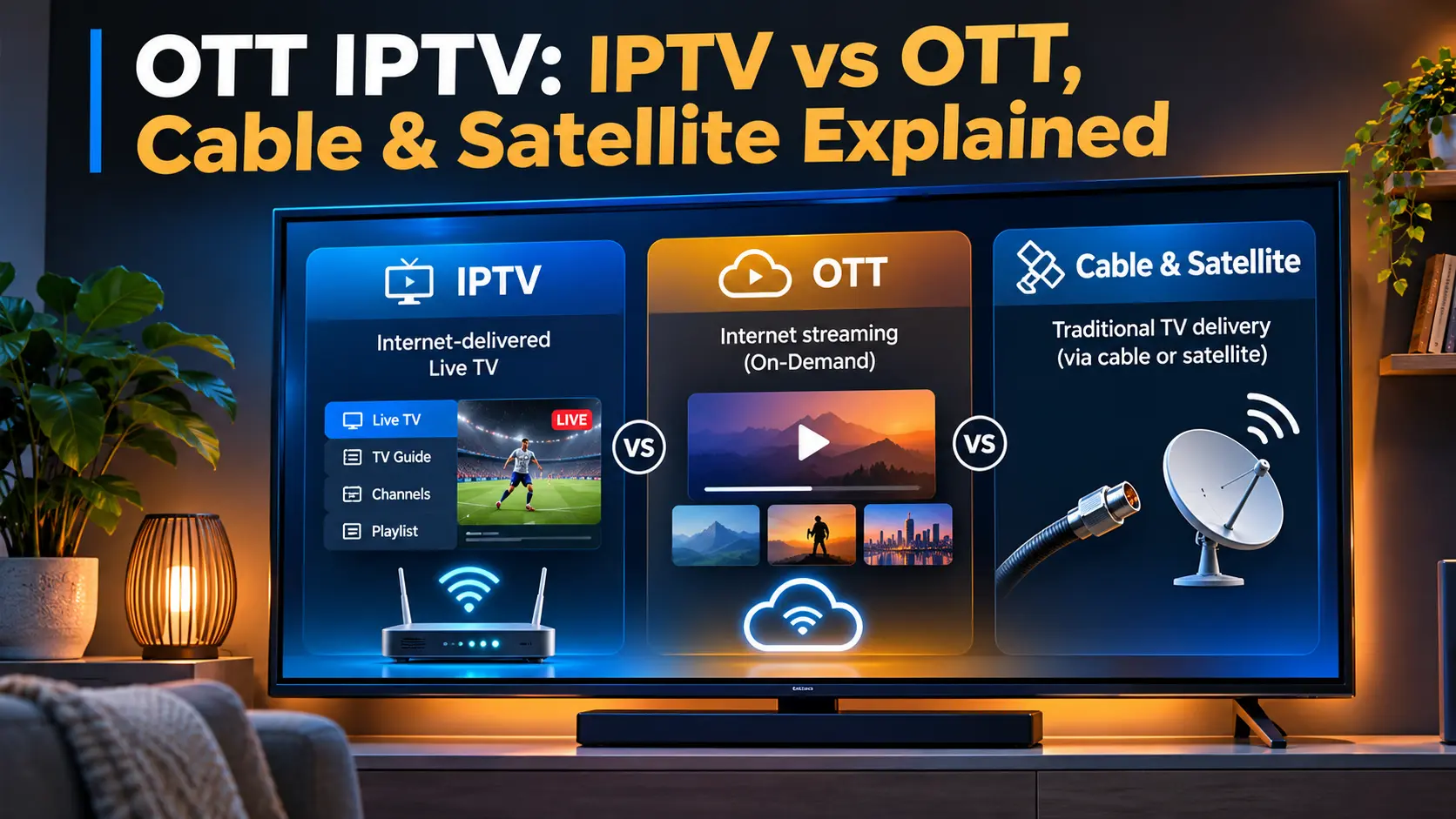

People often type “OTT IPTV” as if it were one thing, but IPTV and OTT are two different ways of delivering TV. The confusion is understandable because both use the internet, both stream video and both run on the same apps and boxes. This guide explains the difference between OTT and IPTV, how each compares with cable and satellite TV, and which option fits your home or business. If you are new to the subject, start with what IPTV is.
TL;DR: Key Takeaways
- IPTV is TV delivered over a managed IP network, usually by an ISP or telecom operator, with controlled quality.
- OTT is video delivered over the open internet, with no network operator controlling quality (Netflix, YouTube and similar services).
- Cable and satellite are older, one-way broadcast systems. IPTV and OTT both rely on your broadband connection.
- All of them are legal when the content is licensed. Unlicensed “IPTV” subscriptions are not.
What Is IPTV?
The International Telecommunication Union (ITU) defines IPTV as multimedia services delivered over IP-based networks that are managed to provide the required level of quality, security, interactivity and reliability. In practice, that means a telecom or ISP runs the network and the set-top box, reserves bandwidth for TV and sells you a channel package. Examples include telco TV services bundled with broadband.
IPTV systems often use IP multicast to send live channels efficiently. That helps explain fast channel changes and stable quality. The IEEE Technology Navigator makes the same distinction: IPTV typically runs over managed networks, while open internet video does not get provider-controlled quality guarantees.
What Is OTT?
OTT stands for “over the top.” The video travels over the public internet, “on top of” your ISP’s connection, without the ISP being involved in the service. You sign up with the content company directly and watch on any device. Netflix, YouTube, Disney+ and live TV services like Sling, Philo and YouTube TV are OTT. OTT often uses adaptive bitrate streaming, which lowers or raises quality depending on your connection.
IPTV vs OTT: The Main Differences
| Feature | IPTV | OTT |
|---|---|---|
| Network | Managed private network | Open public internet |
| Who delivers it | ISP or telecom operator | Content company or app |
| Quality control | Operator controls bandwidth and QoS | Best effort, adapts to your speed |
| Device | Operator set-top box (often required) | Any internet device or app |
| Subscription | Usually tied to the ISP’s broadband | Independent of your ISP |
| Examples | Telco TV bundles | Netflix, YouTube TV, Philo |
Why the Terms Get Mixed Up
Many services sold as “IPTV” online are, technically, OTT, because they stream over the open internet to any app. The label stuck because the channel list and the guide feel like TV. This is why searches like “IPTV OTT,” “OTT and IPTV difference” and “OTT IPTV platform” overlap so much. Whichever term is used, what matters most is whether the provider has the rights to the channels.
Is OTT Better Than IPTV?
Neither is better in every case. IPTV tends to be more consistent for live channels because the operator manages the network. OTT is more flexible because it works on any device without special hardware. Most households today use OTT apps, and telecom operators increasingly offer both. Digital TV Research forecast that IPTV subscribers would pass cable subscribers worldwide in 2026, as reported by CSI Magazine.
IPTV vs Cable TV
Cable sends channels as a broadcast signal over coaxial cable, while IPTV sends them as data packets over broadband. IPTV makes interactive features like catch-up, on-demand and apps easier. Cable usually needs a rented set-top box and often a contract. If you are weighing “IPTV vs cable,” check the full monthly bill including equipment and fees. Our cheap IPTV service guide shows how licensed internet TV prices compare. Forum threads about “IPTV vs cable Reddit” often focus on price, but cost alone should not outweigh legality and reliability.
IPTV vs Satellite TV
Satellite TV uses a dish and a receiver to pick up a one-way signal from a satellite (typically DVB-S or DVB-S2). It works where broadband is weak, and it carries many channels at once. IPTV needs a good internet connection but needs no dish and can offer on-demand and apps. In a “satellite vs IPTV” decision, rural areas with poor broadband may favor satellite, while homes with fast fiber often prefer IPTV or OTT.
Satellite Headend and IPTV
Operators sometimes combine the two. A satellite headend receives satellite feeds, decodes them and converts them into IP streams that are delivered to customers over a network. Equipment such as encoders and transcoders sits in the middle. Learn the basics in our IPTV encoder and HDMI encoder for IPTV guides. The operators who run these systems need content licenses, which our IPTV business solution guide explains.
Satellite IPTV Boxes and Receivers
Some hybrid set-top boxes include a satellite tuner and internet apps in one device. When you shop for an “IPTV satellite receiver,” check that it is a certified device from a known brand. The FBI has warned about malware on generic uncertified Android boxes, in its BADBOX 2.0 alert. Our guide to Android TV boxes for IPTV shows how to choose a safe one, and our IPTV box guide covers other options.
OTT IPTV Players, Apps and Platforms
An IPTV or OTT player is the app that plays your channels. Apps such as OTT Navigator are players that load playlists you supply. They do not include channels. The same applies to most other players, and our roundup of the best IPTV players compares them. If you are choosing an app, make sure it works on your device and supports your playlist type and EPG.
For businesses, an “OTT IPTV platform” or “IPTV OTT solution” usually means the middleware, billing and apps an operator uses to deliver TV. This software is legal to run only with licensed content.
Is OTT TV Legal? The Content Question
Both IPTV and OTT are legal technologies. What matters is whether the provider has the rights to what it sells. A licensed OTT service like Philo or Sling is legal. A seller offering thousands of channels and every sports package for a few dollars almost never has those rights. The Alliance for Creativity and Entertainment (ACE) secured an $18.75 million default judgment in March 2026 against the operator of several illegal IPTV services. See is IPTV legal for a full explanation. This is general information, not legal advice.
How to Choose Between IPTV, OTT, Cable and Satellite
- Check your internet speed. Streaming needs a stable connection, and 4K needs more bandwidth than HD.
- List your must-have channels. Sports and local channels differ by provider.
- Compare the full monthly cost including equipment, fees and taxes.
- Verify the license. Pick providers from our legal IPTV providers list.
- Test before you commit. See how IPTV services work and use a trial where offered.
On-demand libraries matter too. Read what VOD is to see how it fits into both models.
Frequently Asked Questions
-
Is OTT better than IPTV?
Not always. OTT is more flexible and works on any device, while IPTV is usually steadier for live TV because the operator manages the network. Your best choice depends on your internet and what you watch.
-
What is OTT on IPTV?
OTT on IPTV usually means delivering streams over the open internet using IPTV-style playlists and apps. Strictly speaking, that is OTT delivery, not managed IPTV. See what IPTV is for the full definition.
-
Is OTT TV legal?
Yes, when the service holds the rights to its content. Netflix, YouTube TV and Philo are legal OTT services. Unlicensed streams are not. Read our IPTV legality guide.
-
What is the most trusted IPTV provider?
No single provider suits everyone, but trusted ones hold licenses, list prices publicly and offer clear terms. Start with our legal IPTV providers guide, then compare options in our IPTV service overview.
Conclusion: Choosing the Right OTT IPTV Option
OTT IPTV is really two ideas: managed IPTV from a network operator and OTT streaming over the open internet. Both can replace cable or satellite if you have good broadband and a licensed provider. Start with your internet speed and channel needs, then pick a service you can verify. For a safe, trusted starting point, see our guide to the best IPTV players and our legal IPTV providers.