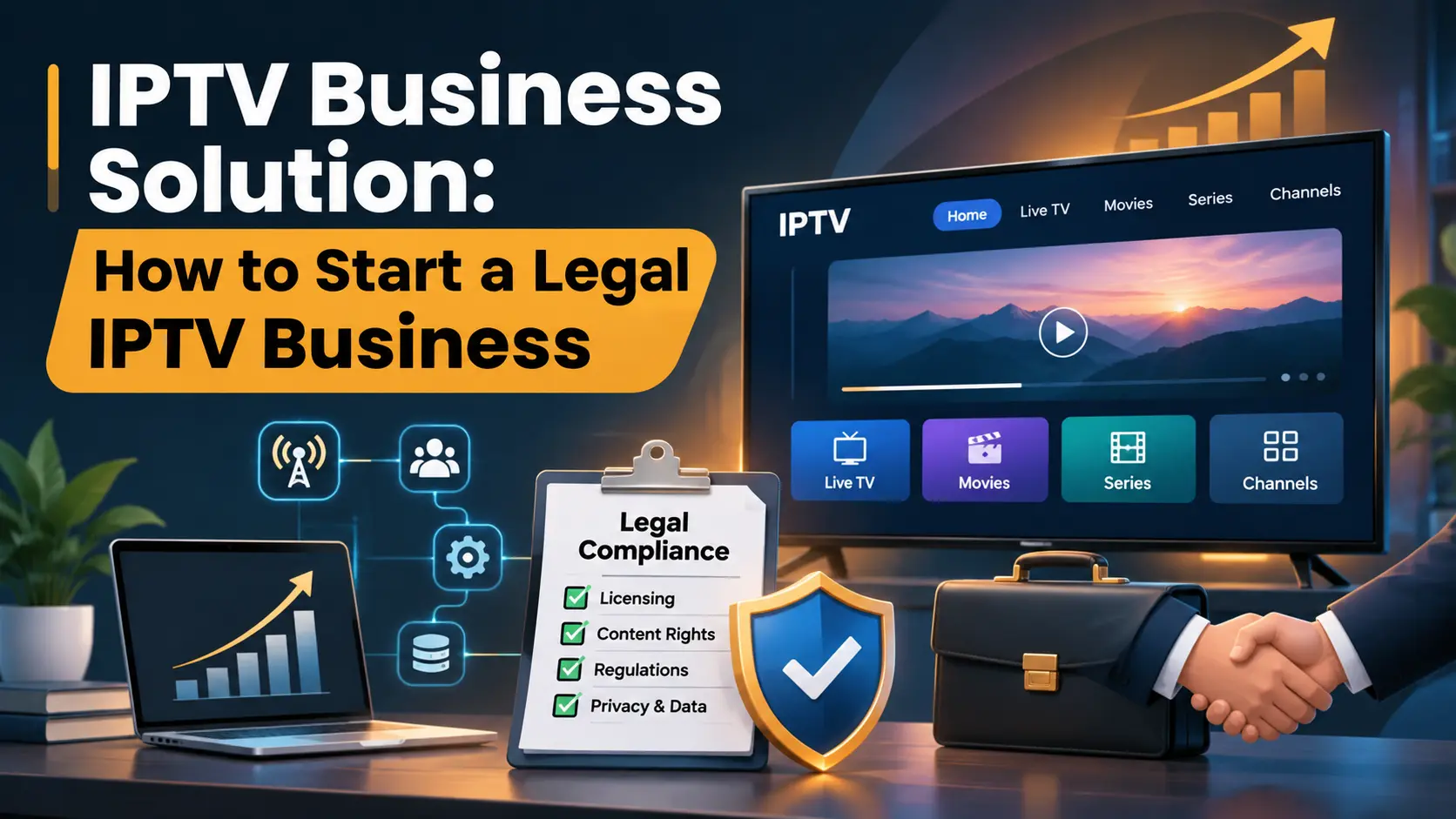

Looking for an IPTV business solution that can actually last? Demand for internet-delivered TV keeps growing, and there are real opportunities for hotels, ISPs, schools and content owners. But the market also attracts people who resell unlicensed streams, and that route ends badly. This guide explains how to start an IPTV business with proper licensing, the right technology and a realistic plan. New to the topic? Start with what IPTV is.
TL;DR: Key Takeaways
- A legal IPTV business needs content licenses. Technology alone is not enough.
- The best opportunities are B2B: hotels, ISPs, hospitals, schools and licensed channel businesses.
- Your core stack is a headend or encoder, middleware, a delivery network, apps or set-top boxes, and support.
- Selling unlicensed streams has led to multi-million-dollar court judgments in the USA.
Is Starting an IPTV Business Worth It?
The market is large, but published estimates differ a lot. Fortune Business Insights values the global IPTV market at $109.34 billion in 2026. Mordor Intelligence estimates $66.63 billion for the same year. The gap comes from how each firm defines the market, so treat any single figure with caution. Digital TV Research forecast that IPTV subscribers would pass cable subscribers worldwide in 2026, as reported by CSI Magazine.
Growth does not guarantee profit, though. Margins depend on your content costs, your customer type and how well you run support. That is why the model you choose matters more than the market headline.
IPTV Business Models: Pick the Right One
Most legitimate IPTV business opportunities fall into one of these models.
1. IPTV for Business: Hotels, Hospitals, Schools and Gyms
You install and manage a private TV system for a venue. This is one of the clearest IPTV solutions for business customers, because the client pays for setup, hardware and a monthly service fee. You still need the right licenses for the channels you deliver.
2. IPTV Business for ISP and Telecom Providers
An IPTV business for ISP customers means bundling TV with broadband. It needs a headend, middleware, content agreements and set-top boxes. It is capital-heavy but can lock in subscribers. Smaller local ISPs often work with a licensed content aggregator instead of signing every broadcaster directly.
3. Licensed OTT or FAST Channels
If you own or license content, you can launch your own channel or app. Free ad-supported streaming (FAST) channels are one growing example of this model.
4. Authorized Reselling and Affiliate Services
You can sell subscriptions on behalf of a licensed provider and earn a commission. Read our overview of an IPTV reseller and ask any supplier for proof of content rights before you sign.
5. Installation, Repair and Support Services
Not every IPTV business needs to own the content. Setup, troubleshooting and hardware services for homes and small businesses have low startup costs and steady demand.
The Legal Reality: What You Must Not Do
Some online threads, including posts on Reddit about how to start an IPTV business, describe cheap reselling of thousands of channels. Those services are usually unlicensed. Rights holders pursue them actively. The Alliance for Creativity and Entertainment (ACE) secured an $18.75 million default judgment in March 2026 against the operator of several illegal IPTV services. That operator also ran a reseller programme. In June 2026, a US court entered a $9 million default judgment against another IPTV operator.
Avoid “cracked” apps and pirated panels too. They add malware and legal risk and cannot be supported properly. For a plain-language breakdown, read is IPTV legal. This is general information, not legal advice.
IPTV Business Plan: Step-by-Step
Use these steps as a simple IPTV business plan template.
Step 1: Choose Your Model and Customer
Pick one target from the models above. A narrow focus, such as small hotels or rural ISPs, is easier to sell to than “everyone.”
Step 2: Register the Business and Check Local Rules
Set up a legal entity and check which licenses apply in your country. Rules differ widely. For example, if you want to learn how to start an IPTV business in the USA or in India, the regulators and licensing requirements are different, and a media or telecom lawyer should review your plan. See our country guides for IPTV in the USA and Indian IPTV for market background.
Step 3: Secure Content Rights
Sign agreements directly with broadcasters, or work through a licensed aggregator. Get the rights in writing, including the territory and the number of viewers allowed. Without this step you do not have an IPTV business solution, only a risk.
Step 4: Build the Technology Stack
A typical stack includes:
- Headend and encoding: hardware or software that prepares live feeds. Learn the basics in our IPTV encoder guide and our guide to an HDMI encoder for IPTV.
- Middleware and billing: manages users, packages, subscriptions and the channel list.
- Delivery: streaming servers and a content delivery network to handle viewers at scale.
- Player apps and devices: branded apps or a set-top box for IPTV.
- Program guide and VOD: an EPG for schedules and video on demand (VOD) for a library.
Step 5: Deploy With Docker (Optional)
Many technical teams use Docker to deploy IPTV software. A containerized IPTV Docker setup makes it easier to move your middleware, web player or monitoring tools between servers and to update them safely. Learn the basics in the official Docker documentation. Docker does not solve licensing. It only changes how you host the software.
Step 6: Price Your Service and Estimate Costs
List your costs: content licenses, servers and bandwidth, software, hardware, support staff and payment fees. Then set prices that leave a margin. Compare with what consumers already pay for licensed services in our cheap IPTV service guide.
Step 7: Test, Then Launch a Pilot
Run a small pilot with one hotel, building or neighborhood. Test stream stability, latency, device support and billing before you scale.
Step 8: Market and Support Your Service
Local partnerships, installers and property managers are strong channels for IPTV for business. Offer clear support hours and a simple fix process. Support quality is often the main difference between providers customers keep and those they drop.
Common Mistakes When You Start an IPTV Business
- Skipping content licenses to keep costs low.
- Underestimating bandwidth and server costs as users grow.
- Relying on a single supplier with no backup feed.
- Offering no support or onboarding.
- Copying “get rich” claims from forums without checking the legal side.
Frequently Asked Questions
-
Is watching IPTV legal in the USA?
Yes, when the service is licensed. Watching through a licensed provider is legal, while unlicensed streams infringe copyright. Read our IPTV legality guide. This is not legal advice.
-
Is selling IPTV profitable?
It can be, but there is no guaranteed margin. Profit depends on content costs, customer type and support. Licensed B2B models are steadier than reselling cheap streams, which carries legal risk.
-
How to do IPTV business?
Choose a legal model, register the business, secure content rights, build or rent a technology stack, run a pilot and then scale. Our guide to an IPTV service shows what customers expect.
-
What is the most trusted IPTV provider?
No single provider is best for everyone. Look for licensed content, a public price and a clear refund or trial policy. Our comparison of legal providers lists examples, and our IPTV service guide explains how to judge one.
Conclusion: Build an IPTV Business Solution That Lasts
A strong IPTV business solution combines licensed content, reliable technology and good support. Start small, pick a clear customer and prove the model before you scale. If you plan to sell through partners, review our guide to an IPTV reseller and the legal basics in what IPTV is to avoid expensive mistakes.